


DwarfLab Draco SHO Edition Smart Telescope
£1,449.00 VAT inc
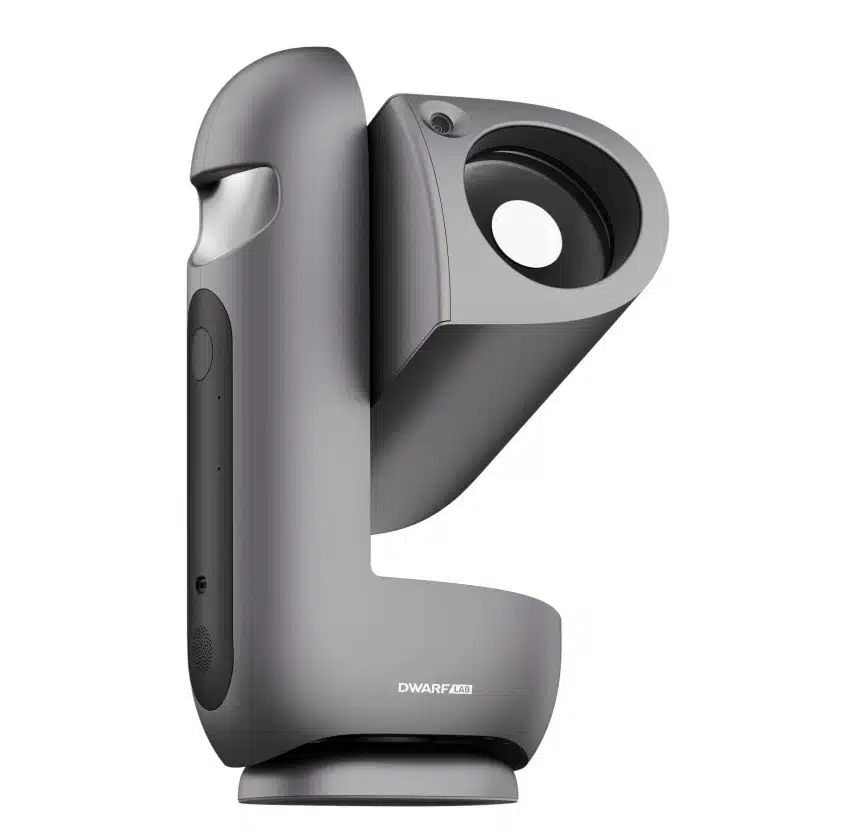
The versatile all-round DwarfLab Draco SHO Edition for users who want a powerful, easy-to-use smart observatory for general astrophotography, solar imaging, and multi-scenario use. A new kind of observatory. One you can carry
Please Check Availability
- Are You Visiting Our Store? CLICK HERE For Today's Availability
- Delivery or Click n Collect
- 28 Days Returns Policy
Wide Angle 23.3mm Equivalent Focal Length. D 85.74° / H 73.20° / V 58.23° An ultra-wide field of view, made for the vast night sky. Capture the Milky Way, star trails, and sweeping landscapes with ease.
Telephoto 1200mm Equivalent Focal Length 12MP high-SNR deep-sky output, built to capture distant galaxies, faint nebulae, and fine deep-sky structure.
Designed as a high-end portable observatory, this single compact system is capable of imaging deep-sky objects like nebulae and galaxies, as well as solar, lunar, and planetary targets.
Stars, stay true to the edge. A 90mm aperture defines the physical ceiling of image quality. To truly reach it, every beam of light must be precisely controlled. Draco uses an aberration corrected optical system to precisely correct light deviation deep within the lens set. From the center to the edge of the frame, stars stay pin sharp. A leap in image quality, and an elegant answer to physics.
CMOS cooling for lower noise: Built-in cooling and heat dissipation reduce thermal noise at the source, creating an exceptionally clean data foundation. Automatic lens dew prevention: Reused sensor heat is directed to warm the lens precisely, keeping the view clear and transparent through the night. From -20°C winter nights to 45°C summer heat, Draco runs steadily, protecting every frame from capture to final image.
Folded Optical Design. Big aperture. Compact by design. 386mm Body | 90mm Aperture | 340mm Focal Length Inside this body, Draco folds a 90mm aperture and 340mm focal length into a compact optical path.
Super Fast F3.8 Focal Ratio. Exceptionally fast at F3.8, Draco delivers around 2.2× the light throughput of typical F5.6 systems, capturing more light in less time. A faint nebula signal that once took 6 hours to gather can now be captured sharply in under 3 hours. With 300 second ultra-long exposures.
Physical CMOS Rotation. Your setup should follow your vision. Not the other way around. With Draco, you can rotate the frame directly in the app, while the CMOS sensor physically turns to match. Go wide. Go vertical. Go off-axis. Just the frame you had in mind. Compose Freely. Define Your Own Angle.
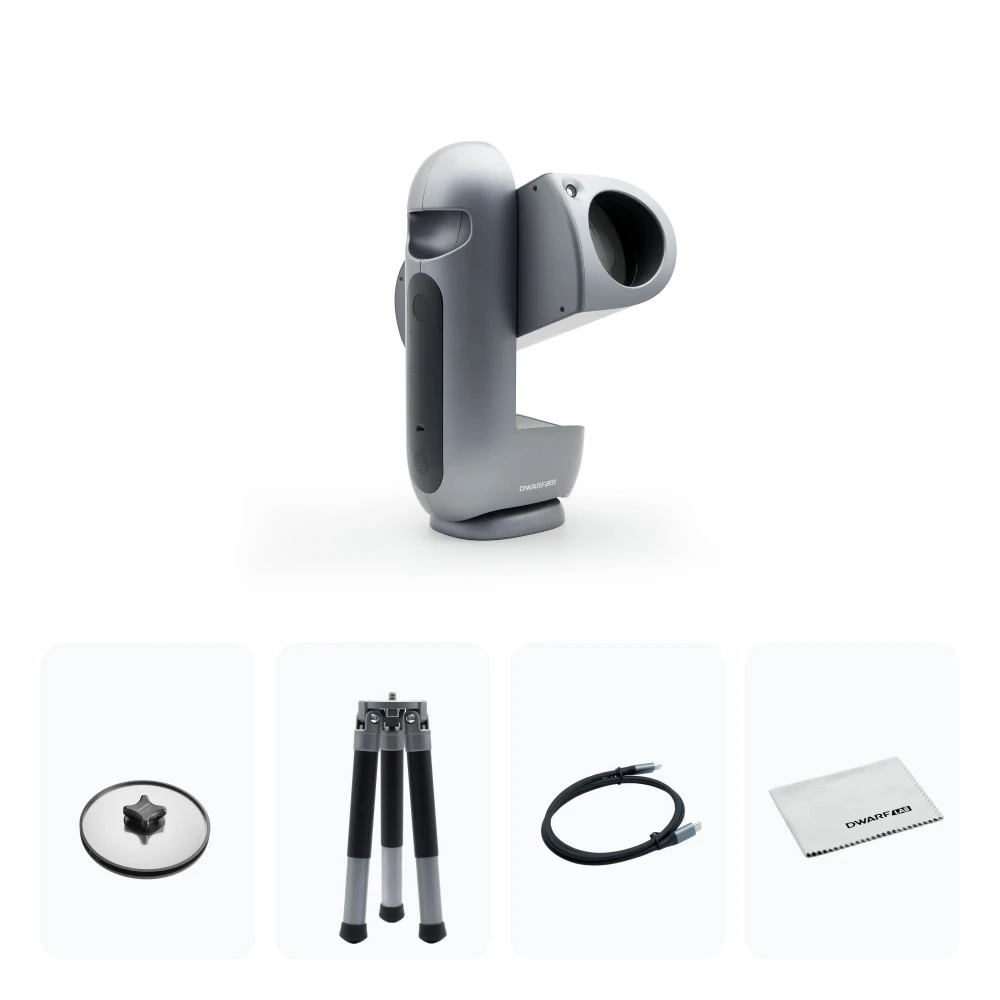
Draco comes with an aluminum-alloy tripod, with an aluminum platform, connectors, and legs for reliable support without unnecessary weight. TPR feet provide added grip on the ground for greater stability.
Weighing approximately 480 g, the tripod stands 175mm high when deployed, with a 470 mm footprint diameter and a compact folded size of just 80 × 80 × 268 mm. An 80 mm top platform with a 3/8”-16 mounting thread provides a secure connection, while the fixed-length legs open to a preset angle for quick setup.
5.5kg body. Light enough to carry with one hand, so you can take serious imaging power far beyond the backyard.
Automatic, Yet Fully in Your Control. In Auto Mode, Draco intelligently adjusts settings for each target. Switch to Pro Mode for full control over exposure, gain, filters, and more. With exposure times from 1/10000 s to 300 s, you have the flexibility to capture different targets and explore more creative possibilities.
Whats in the box
OPTICAL SYSTEM Aperture diameter 90 mm (telephoto) 2.96 mm (wide-angle) 90 mm (telephoto) 2.96 mm (wide-angle) Focal Length 340 mm (telephoto) 5.56 mm (wide-angle) 340 mm (telephoto) 5.56 mm (wide-angle) 35 mm-Equivalent Focal Length 1200 mm (telephoto, astronomy mode) 1280 mm (telephoto, non-astronomy mode) 23.3 mm (wide-angle) 1200 mm (telephoto, astronomy mode) 1280 mm (telephoto, non-astronomy mode) 23.3 mm (wide-angle) Field of View Astronomy Mode (Deep Sky / Solar System) D 2.059°(telephoto); D 85.74°(wide-angle); H 0.905°, V 0.512° (guiding) Other Modes D 1.936°(telephoto); D 85.74° (wide-angle); H 0.905°, V 0.512° (guiding) Astronomy Mode (Deep Sky / Solar System) D 2.059°(telephoto); D 85.74°(wide-angle); H 0.905°, V 0.512° (guiding) Other Modes D 1.936°(telephoto); D 85.74° (wide-angle); H 0.905°, V 0.512° (guiding) Focusing Distance (Telephoto) 25 m–∞ 25 m–∞ Built-in Filters Telephoto Astro: 440 ~ 680 nm Dark: Fully opaque H+O Dual-Narrowband: CWL 1: O III 503 nm | FWHM 13 nm CWL 2: Hα 658 nm | FWHM 13 nm ND: OD 5 @ 400 ~ 1000 nm Wide-Angle VIS: 430 ~ 565 nm ND: OD 5 @ 400 ~ 1000 nm Telephoto Astro: 440 ~ 680 nm Dark: Fully opaque H+O Dual-Narrowband: CWL 1: O III 503 nm | FWHM 13 nm CWL 2: Hα 658 nm | FWHM 13 nm S+O Dual-Narrowband: CWL 1: O III 503 nm | FWHM 13 nm CWL 2: S II 674 nm | FWHM 13 nm Wide-Angle VIS: 430 ~ 565 nm ND: OD 5 @ 400 ~ 1000 nm IMAGING SYSTEM Image Sensor Telephoto: OV50Q40 Wide-angle: OV50E40 Guiding: OS04C1B (monochrome) Telephoto: OV50Q40 Wide-angle: OV50E40 Guiding: OS04C1B (monochrome) Sensor Optical Format 1/1.3″ (uncropped) 1/1.3″ (uncropped) Native Pixel Size 1.197 µm 1.197 µm Pixel Size After Binning 2.394 µm (2×2 binning) 2.394 µm (2×2 binning) Sensor Resolution 50.33 MP (telephoto) 50.33 MP (wide-angle) 4.09 MP (guiding) 50.33 MP (telephoto) 50.33 MP (wide-angle) 4.09 MP (guiding) Output Image Resolution 12 MP (telephoto, 2×2 binning) 12 MP (wide-angle, 2×2 binning) 12 MP (telephoto, 2×2 binning) 12 MP (wide-angle, 2×2 binning) Aspect Ratio 4:3 4:3 MOUNT & TRACKING Motor Speed 0.001°/s–12.83°/s (0.06°/min–770°/min) 0.001°/s–12.83°/s (0.06°/min–770°/min) Rotation Range Tilt: 225° Rotation: 360° Tilt: 225° Rotation: 360° Movement Range Tilt: 225° Rotation: 360° Tilt: 225° Rotation: 360° Field-Derotation Speed 0.001°/s–12.83°/s (0.06°/min–770°/min) 0.001°/s–12.83°/s (0.06°/min–770°/min) Mounting Threads 3/8″ (1) 1/4″ (2) 3/8″ (1) 1/4″ (2) POWER & CONNECTIVITY Battery Built-in, 7.7 V, 10000 mAh supports external USB charging Built-in, 7.7 V, 10000 mAh supports external USB charging Power Input Type-C Type-C Connectivity (Operating Range) Wi-Fi, Bluetooth, NFC (Wi-Fi up to 10 m) Wi-Fi, Bluetooth, NFC (Wi-Fi up to 10 m) Storage Built-in 128 GB Built-in 128 GB SOFTWARE & MEDIA Shooting Modes Photo (telephoto and wide-angle) Video (telephoto and wide-angle) Astronomy (telephoto and wide-angle) Panorama (telephoto and wide-angle) Burst (telephoto and wide-angle) Time-lapse (telephoto and wide-angle) Photo (telephoto and wide-angle) Video (telephoto and wide-angle) Astronomy (telephoto and wide-angle) Panorama (telephoto and wide-angle) Burst (telephoto and wide-angle) Time-lapse (telephoto and wide-angle) Compatible OS iOS & Android iOS & Android File Formats JPG, MP4, RAW (FITS, TIFF), PNG JPG, MP4, RAW (FITS, TIFF), PNG NPU 6 TOPS 6 TOPS Streaming Protocol RTSP supported (Real-Time Streaming Protocol) H.264 / H.265 RTSP supported (Real-Time Streaming Protocol) H.264 / H.265 PHYSICAL & ENVIRONMENT Weight 5.5kg 5.5kg Dimensions (W × H × D) 385.85 × 196.28 × 133.25 mm 385.85 × 196.28 × 133.25 mm Operating Temperature -4–113°F / -20–45°C -4–113°F / -20–45°C
What is Draco, and who is it for? Draco is a portable, all-in-one smart observatory designed for deep-sky imaging and multi-scenario astronomy. It combines a 90 mm aperture, 340 mm focal length, fast f/3.8 optics, 300-second exposures, a built-in guide scope, physical CMOS field rotation correction, dual cameras, and an automated app workflow in a 5.5 kg body. It also supports EQ Mode for more stable tracking and deeper imaging. Draco is suitable for beginners who want a simpler workflow and for advanced users who want Pro Mode and FITS/TIFF export.
How is Draco different from DWARF 3 and DWARF mini? DWARF mini is the most compact option and is aimed at simple entry-level use. DWARF 3 is a portable multi-scenario telescope for deep-sky and wide-angle imaging. Draco is the performance-focused step up, with a larger aperture, faster optics, longer single-frame exposures, built-in guiding, field rotation correction, EQ Mode, and a more observatory-like imaging workflow.
Standard Edition vs SHO Edition Draco is available in two versions. The Standard Edition is the general-purpose model and includes a built-in solar filter for solar imaging. The SHO Edition is the nebula-focused version and uses an external magnetic filter system for SHO imaging and composite output.
Can Draco replace a traditional telescope? Draco brings together target finding, tracking, guiding, field rotation correction, capture, stacking, and mobile processing in one integrated system. It simplifies workflows that would normally require multiple pieces of a conventional astrophotography rig. Because it does not include an eyepiece for live visual observation, it is best viewed as a powerful imaging-focused complement to a traditional telescope.
What can Draco capture? Draco supports deep-sky, Solar System, Milky Way, star-trail, time-lapse, panorama, and automatic-tracking scenarios. It is designed for galaxies, nebulae, clusters, the Sun, the Moon, and planets, as well as wider sky compositions and landscape-style imaging.
Can both cameras shoot at the same time? Yes. Draco can record telephoto and wide-angle views in the same session, giving users both the target detail and the wider scene.
Can Draco capture deep-sky objects from a city? Yes. Bright clusters, brighter nebulae, the Moon, and the Sun are suitable city targets. Fainter objects such as galaxies and dust structures will benefit from darker skies.
Can Draco photograph the Milky Way? Yes. The wide-angle camera and Milky Way mode support Milky Way imaging, while final results will depend on sky conditions, moon phase, cloud cover, and total capture time.
Can Draco image the Sun safely? Yes, using the approved solar workflow. The Standard Edition uses the built-in solar filter, while the SHO Edition uses the external magnetic filter system as configured. Users should always follow the in-app safety flow and never point Draco at the Sun outside the approved workflow.
Can Draco capture the Moon and planets? Yes. Draco supports lunar and planetary imaging with high-resolution output from the main camera.
Can Draco create star trails, time-lapse videos, panoramas, or tracking shots? Yes. Draco supports star trails, time-lapse video, panorama, and automatic tracking.
Will my images look the same as sample images? Image quality varies with sky brightness, cloud cover, moon phase, target altitude, seeing, total capture time, stability, focus, and processing choices. Sample images show what Draco can achieve under specific conditions, but results will vary.
Specifications
Specifications
Reviews
Sorry, no reviews match your current selections

