If you are interested in learning more about space and the celestial objects that inhabit our universe, then your first step is likely to be purchasing a telescope. With so many brands, types, specifications, and prices, it can sometimes be hard to know what would be best for you.
Here at Grovers Optics, we have the largest range of telescopes in the north in stock and ready to buy, and our team our experts at finding the right product for what you need. We have put together our three top tips for choosing your first telescope to help you start your journey to seeing the night sky in all its beauty!
Tip one : Magnification vs Aperture
These are two of the most likely terms you will see when it comes to the specification of a telescope. The aperture refers to the diameter of the main lens or mirror inside your telescope, the greater the aperture, the more light can be let in, allowing distant objects to become visible. The magnification simply refers to the amount that a telescope can enlarge its subject.
If you have a large magnification but a smaller aperture, then that means that although the object will appear closer, it will also be blurry and lack detail. If you choose a telescope with a larger aperture but smaller magnification, then your telescope is likely to be on the large side and not be easily portable! So, what do you choose?
Tip: The best way to discover what telescope is right for you, is to look at the f-ratio (or f/). This is the focal length of the telescope divided by the aperture. In layman’s terms, you want a smaller f-ratio number if you are planning on observing far away galaxies, whereas larger f-ratios are ideal for closer celestial objects such as the planets. If you are just starting out, then a smaller to medium f-ratio for your telescope is a good way to go.

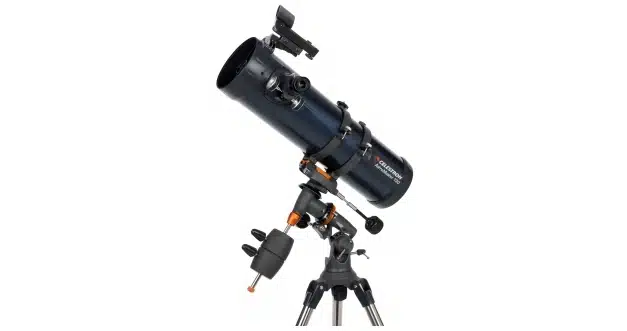
Check out our Celestron AstroMaster 130 Telescope – with a focal ratio of f/5 it’s ideal for searching the skies, near and far.
Price: £199.00 – more information
Tip two: Types of Telescopes
There are different types of telescopes you are likely to come across during your search. These can be broken down into around three main categories, refractors, reflectors or cassegrain.
Refractor telescopes are made from one or more lens. So, when the light passes through the objective lens, it refracts the light to create an image which the eyepiece lens then magnifies.
Reflector telescopes let in more light than refractors thanks to their use of mirrors instead of lenses. They are sometimes referred to as Newtonian telescopes as they were invented by Sir Isaac Newton.
Cassegrain telescopes use both mirrors and lenses to create an image, allowing high magnification, a wider field of view and in a more compact size.
Tip: Which type should you go for when choosing your first telescope? This may come down to budget. Whilst they are normally more “brilliant” Cassegrain telescopes are more expensive than reflectors & refractors. So if you are just starting out, then your choice is probably going to be a Newtonian or a refractor telescope. There is no right or wrong answer to this one, we would, however, recommend asking for more details & sharing your ambitions with us.

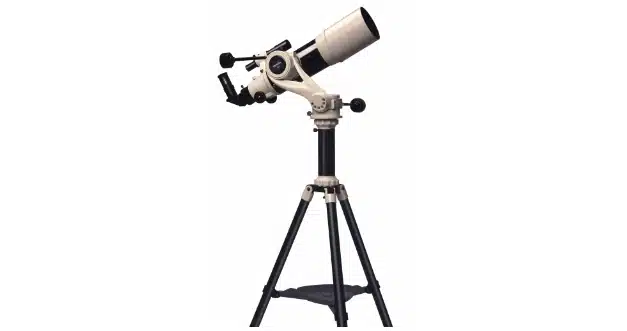
Our SkyWatcher 102 AZ5 is not only a great refractor telescope but you can also use it as a spotting scope for activities during the day!
Price: £369.00 – more information
Tip three: Telescope Mounts
Although most telescopes will come with a mount, it is always worth having all the information before embarking on any telescope purchase.
There are several types of mounts to consider, an alt-azimuth (Alt-Az) mount which allows you to move up and down and from side to side, an equatorial mount (EQ) which has two axis & one of which is aligned with the rotational axis of the earth. You may also see the term Dobsonian telescope. Named after its inventor John Dobson, this refers to a gimbal style Alt-Az mount that usually uses Newtonian optics.
Either an Alt-Az, EQ or Dobsonian can be computerised letting you choose the object you want to look at. The telescope will move to that object & track it. These are called Go-to telescopes & can be operated from your smartphone or tablet.
Tip: If you are a beginner, then you are likely not to be worried too much about mount types or size, which is why we recommend sticking with an alt-az, Dobsonian which may or not be a Go-to telescope, for ease of use.

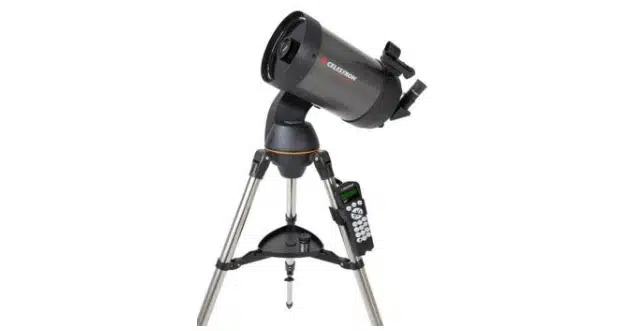
Our grab-n-go computerised telescopes are highly portable, so you can view the stars from anywhere! The Celestron NexStar 6 SLT Telescope is our best seller and is a great option for the avid stargazer.
£749.00 VAT included – more information
If you want to know more about choosing your first telescope, then you can always come visit us in-store. Not only are our friendly team available to answer any questions or queries you may have but you can also see before you buy to ensure you choose a telescope that feels right for you. We have telescopes from the leading brands, and they are available in stock to collect or deliver.
Telescope gift vouchers are also available to purchase for loved ones and would make a fantastic present!
Alternatively, you can call us on 01609 898098 or email us at admin@grovers.biz and one of our team will be happy to help!